A Palletizing Machine-Dual M-Stack
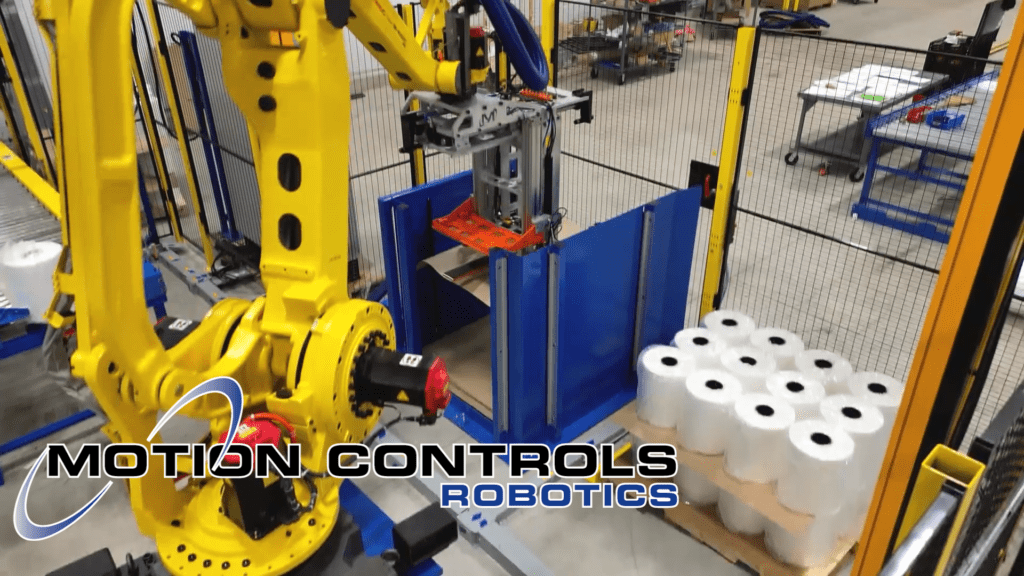
As an advanced industrial automation palletizer, the Dual M-Stack delivers reliable, high-speed palletizing across two product lines. This system is…
Read ArticleTech Talk • Autonomous Mobile Robots (AMRs)
Moving bulky products from anywhere to anywhere inside a facility is a challenge across nearly every industry. This guide covers what must be defined for the project upfront. These items include: load support, travel paths, safety zones, and integration. AMR transport is predictable, safe, and scalable.
Quick takeaway
AMR success with bulky loads depends on defining the load, the path, and the safety zones before deployment.
Core principle: For bulky product handling, successful AMR deployments are built on three definitions: the load, the path, and the safety zones.
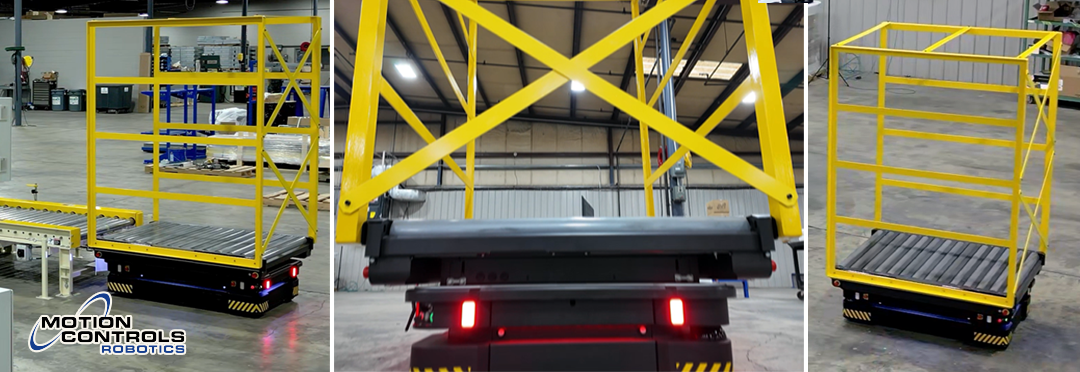
One of the first questions to answer is how the product will be supported and protected during transport. With bulky loads, simply setting it on the AMR is rarely enough. The transport approach must keep the load consistently positioned so the AMR can travel, stop, turn, and charge without surprises.
Many applications use a custom fixture, frame, or deck designed specifically for their product form, size, and shape. The goal is to reduce variation. A good fixture improves repeatability, simplifies docking, and makes handoff more reliable.
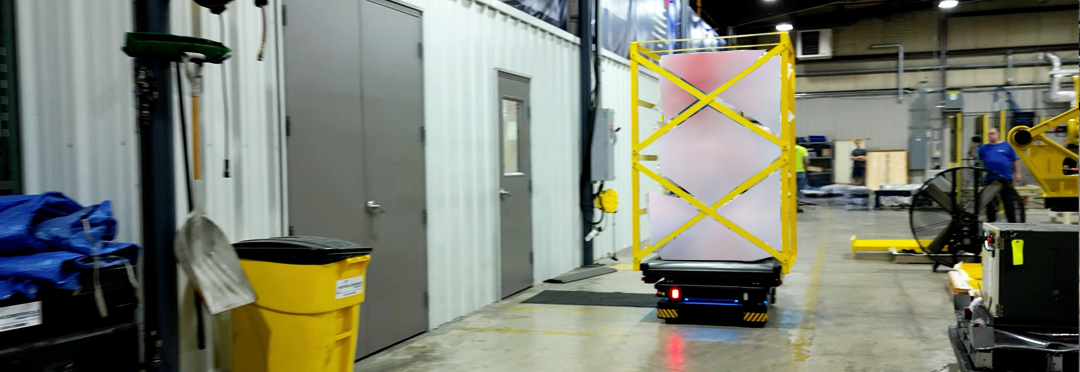
After the load is defined, the next critical decision is the travel path. AMR routes must be evaluated at floor level (cables, pallet corners, ramps, debris, uneven seams) and through the full height of the load envelope (door headers, low-hanging cables, rackings, safety fencing, mezzanine supports).
AMR paths are software-defined, which is a major advantage: routes can be updated as layouts evolve or as volumes shift between processes. But that flexibility doesn’t remove the need for good initial planning. The most successful deployments standardize traffic patterns and create predictable lanes and interaction/stop zones.
Path tip
Validate every route using the largest load size and worst-case turn. Don't just use the average day product.
Traffic tip
Create defined and marked interaction points (pick/drop, crossing zones) so people learn what to expect.
Change tip
Keep a simple "route change" process so edits are controlled and documented as layouts change.
AMRs bring built-in safety capabilities such as obstacle detection, safety scanners, and intelligent navigation. This helps them operate around people and equipment. For bulky products, those safety considerations become even more important because the load can expand the effective operating footprint and reduce visibility in tight areas. A practical safety plan combines AMR safety features with facility rules: signage, right-of-way expectations, and clearly defined crossing points. In many cases, reducing forklift traffic becomes a primary safety win by creating less speed variation, fewer blind corners, and fewer unexpected interactions.
“AMRs give teams a flexible way to move bulky product without disrupting people or processes. When load information, travel paths, and safety zones are defined early, the system is easier to integrate and scale.”
— Kevin Harmon, Lead Application Engineer, Motion Controls Robotics
The business case for AMRs often comes down to consistent flow. When product transport depends on forklifts, timing can vary with operator availability, competing priorities, and congestion. AMR transport creates a more predictable pattern: loads move when they’re ready, and routes can be scheduled or prioritized based on process needs.
To keep throughput consistent, it’s important to design the system as a connected workflow. That means defining pickup and drop-off timing, confirming station readiness signals, and ensuring the AMR can dock reliably every time.
Use this checklist to align engineering, operations, and safety before deployment. Defining these items early reduces rework, improves system acceptance, and makes scaling easier.
Load + fixture
Route + environment
Process + performance
What should be defined first: the AMR route or the load?
Start with the load definition. Once the load is defined, route planning becomes more accurate because clearances and turning requirements are known.
Do AMRs eliminate forklifts completely?
Not always. Many facilities use AMRs to remove forklifts from the most congested or repetitive routes, which can significantly reduce traffic and improve safety without changing every workflow at once.
How do AMRs handle changes in the environment?
AMRs use onboard sensors and safety logic to detect obstacles and respond by slowing, stopping, or rerouting based on configured rules. For bulky loads, it’s especially important to define clear interaction zones and exception handling early.
What’s the biggest mistake with bulky-load AMR projects?
Underestimating the importance of the full load envelope. Routes that work for an empty AMR may not work for the maximum load height/width. Define the envelope early and validate the route accordingly.
If you’re evaluating AMRs for bulky product movement, MCRI would be happy to integrate an AMR(s) with or without a robot into your facility.
Talk with MCRI