MCRI Tech Talk · Tire Manufacturing
Automated Bladder Spraying for Tire Manufacturing
A controlled release coating helps curing bladders expand evenly, supporting bladder life and tire uniformity.
Summary
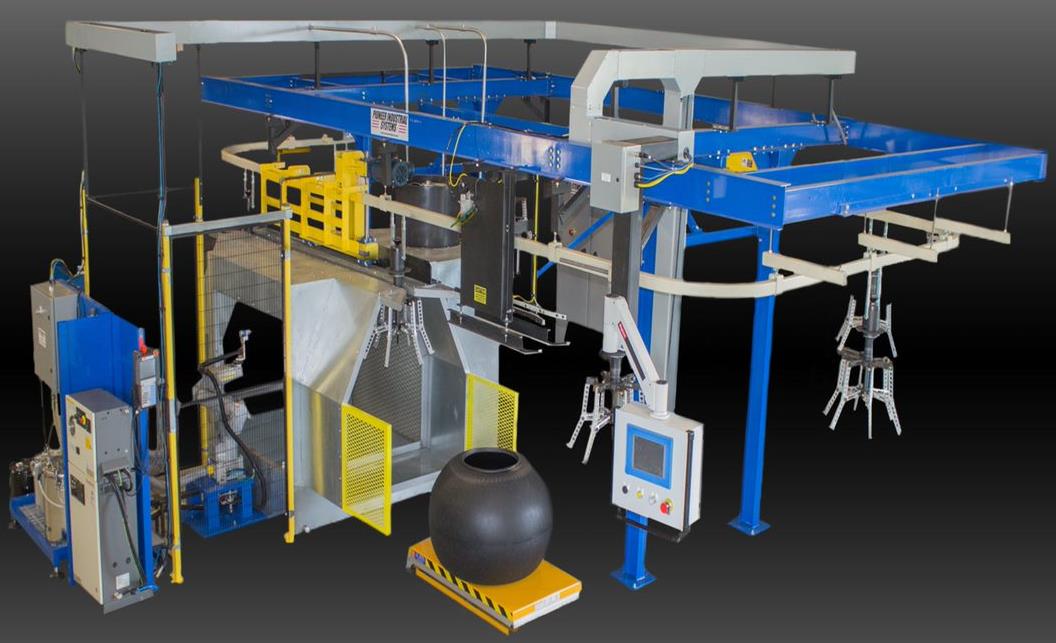
A curing bladder supplier needed an automated bladder spraying system to apply a consistent release coating before shipment to tire manufacturers. The solution combined conveyor handling, automatic measurement, and precision fluid delivery to adjust the spray pattern and volume for each bladder size.
The Challenge - Bladder Spraying
The customer’s technical service engineer represented a global rubber additives business that supplies curing bladders to the tire industry. The goal was to coat new bladders consistently before delivery to tire manufacturers.
Curing bladders are required in the molding or curing of tires. When the uncured, or ‘green,’ tire, is placed in the mold the bladder fills the inside of the green tire and when pressurized drives the tire into the details of the mold thus establishing the tread pattern, sidewall design and final shape.
Bladders work through a severe duty cycle. A key performance measure is the number of cure cycles completed before replacement is needed. A lubricated surface helps the bladder expand uniformly inside the green tire. If it sticks in spots, the expansion forces become uneven. That can affect tire uniformity and shorten bladder life.
Bladder lubrication is achieved both by coating new bladders and by spraying green tires. This application focused on spraying new bladders before delivery, providing the supplier’s customers with a prepared surface that supports longer bladder life and more uniform cured tires.
The Solution
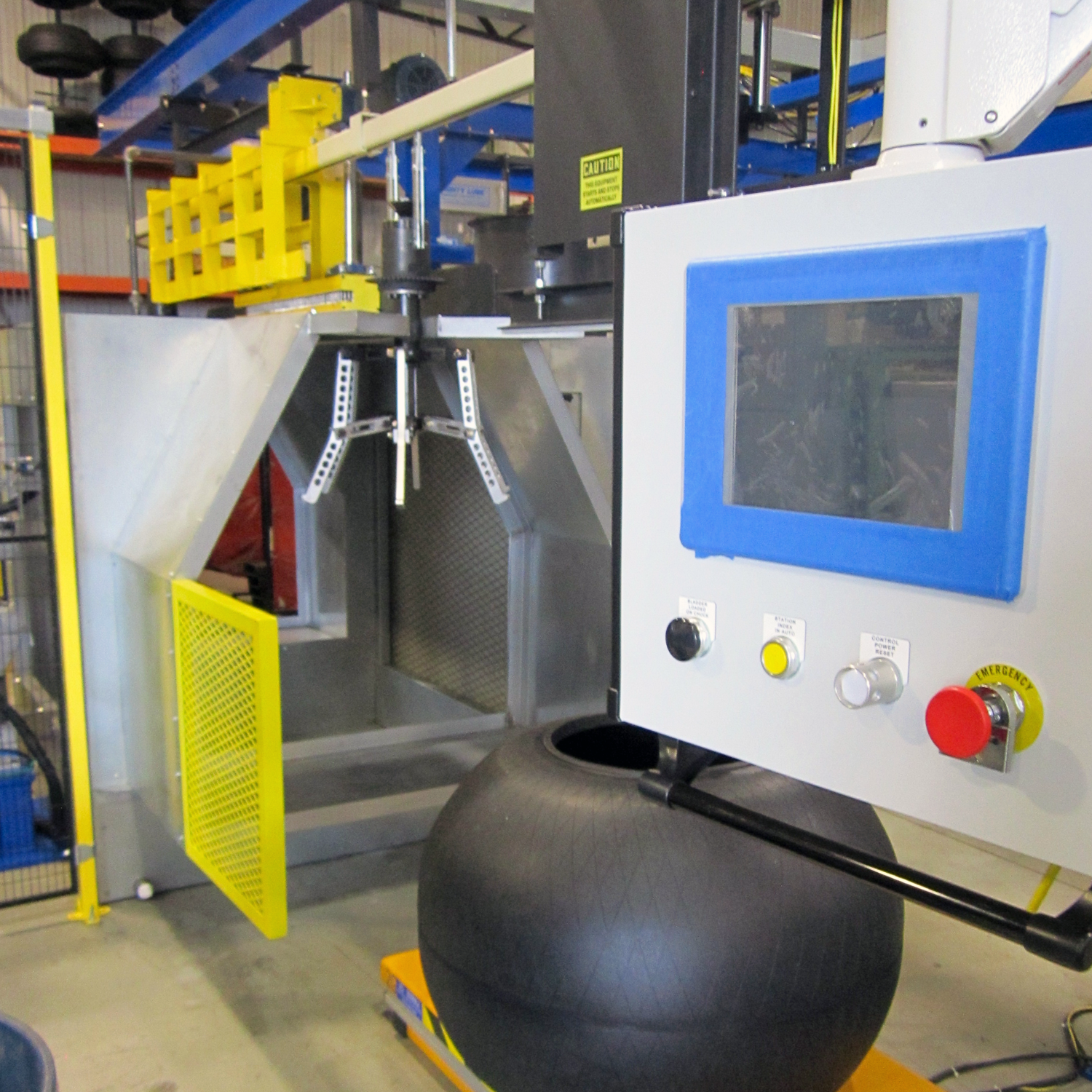
The customer selected an automated bladder spray cell that brought together experience in green tire spraying, tire handling, and controlled fluid application. The patented Precision Fluid Delivery System (PFDS) applied a uniform coating, adjusting the spray pattern and fluid volume to match the bladder dimensions.
Each bladder hung from a gripping chuck mounted on a chain conveyor. As it moved along the conveyor, a light curtain measured its dimensions and sent that information to the PFDS. The system adjusted the spray recipe for the bladder entering the booth. After spraying, the conveyor carried the coated bladder to the unload station.
Project Approval and Engineering
The proposal outlined the automation approach and included a cycle time analysis. This gave the customer the information needed to present the bladder spraying system to leadership. The project met the required specifications, received budget approval, and moved forward with a purchase order.
A defined machine building process began with detailed engineering kickoff meetings. The project team worked with the customer to secure approval of the mechanical layouts, electrical schematics, and programming structure. Regular updates continued as the equipment was assembled.
Runoff, Installation, and Training
The customer completed a full day of runoff testing, verifying performance, maintainability, and both teams’ checklists. Early planning and communication kept final changes minimal.
The system was then disassembled, shipped, and installed in five days thanks to its modular design. A project engineer supervised installation and stayed the following week to connect plant conveyors and the higher-level server, complete commissioning, and train operators, maintenance personnel, and the plant engineer.
Documentation and Follow-Up Support
The customer received machine drawings, a detailed operating manual, current robot and PLC programs, and a spare parts list on a memory stick.
A complimentary six-month maintenance visit was scheduled. The follow-up service included fluid system recalibration, spray gun cleaning and adjustment, and a thorough equipment inspection. A trip report documented the work, along with a quote for a return service visit and any additional spare parts required.
The Sequence of the Bladder Spraying Process
Load
A new bladder is suspended from a gripping chuck mounted on the chain conveyor.
Measure
The conveyor moves the bladder through a light curtain to capture its dimensions.
Adjust
Dimensional data informs the PFDS spray recipe, adjusting the fluid pattern and volume.
Spray
The bladder enters the spray booth, where the system applies the release coating.
Unload
The conveyor carries the coated bladder to the unload station.
Robot and Safety Considerations
The bladder spraying process combines conveyor handling, dimensional measurement, and precision fluid delivery. Robot selection and safeguarding for a new application depend on the process, product, operator access, and maintenance requirements. MCRI evaluates those needs as part of system planning.
The Benefit for the Customer
After installation and commissioning, the bladder spraying system entered production. It gave the supplier a repeatable way to apply a consistent release coating to new bladders before shipment.
For the supplier’s tire manufacturing customers, the value starts with a properly prepared bladder. A consistent lubricating coating supports uniform expansion during curing, helping extend bladder life and maintain tire uniformity. Automatic adjustments to the spray pattern and volume allow the system to accommodate different bladder dimensions while keeping the coating process controlled.
Looking to improve consistency in bladder spraying or green tire spraying?
Talk with MCRI about your tire automation process